April 24th, 2024

A great smile can go a long way. Scientific research suggests that people who smile are perceived as more attractive and confident than those who don’t flash their pearly whites. When it comes time to invest in orthodontics to improve your beautiful smile, choosing the best option can be daunting. Comparing Invisalign to traditional braces is a great way to determine what orthodontics make most sense for your unique smile.
How is Invisalign different?
Unlike traditional braces, in which brackets are affixed onto each tooth and connected by wires Invisalign corrects orthodontic problems using a set of clear trays. These trays are specially formed to fit your teeth, allowing you to wear them 24/7.
Aesthetics
One of the primary advantages of Invisalign is that the clear trays are nearly invisible. Particularly for adults self-conscious about appearing professional with traditional braces, Invisalign can correct orthodontic issues without capturing the notice of others. Their nearly invisible appearance is one of the topmost reasons that orthodontic patients choose Invisalign.
Complexity of the Orthodontic Problem
Invisalign works well for people who have relatively minor problems, such as crooked teeth or small gaps between teeth. For more complex problems, particularly issues with bite or vertical problems (i.e., one tooth being significantly higher than another), traditional braces may be better at pulling teeth into alignment.
Eating and Drinking
Invisalign trays are removable, meaning that you cannot eat or drink while wearing them. Unlike traditional braces, however, you are not limited in the foods you may eat. Chewy, sticky, or hard foods may be eaten, provided that you brush your teeth before reinserting the Invisalign trays.
In the end, only you can weigh the pros and cons of Invisalign versus traditional braces. Consult with Dr. Mark L. M. Powell to understand how these orthodontic interventions may work for your unique situation.
April 24th, 2024

Clear aligners like Invisalign® have become increasingly popular over the past several years and rightly so. They’re removable, easier to clean than braces, and hardly anyone knows you're wearing them. They are great in treating many cases, but they aren't for everyone.
Below, Dr. Mark L. M. Powell and our team cover some of the instances where clear aligners just aren't the answer:
- If drastic tooth movement is required – Fixed appliances deliver much more significant tooth movement. So if your case is a drastic one, clear aligners may not be the best choice.
- If you need to move molars – Molars have much stronger roots than your other teeth and would require significantly longer to move with clear aligners. A fixed appliance is the best choice in this instance, especially if you have a substantial overbite or underbite that needs to be dealt with.
- If you're the type who often forgets or loses things –If you would forget to wear your aligners for the prescribed amount of time (usually at least 22 hours per day), clear aligners are probably not the best choice for you. Forgetting to wear them can delay treatment and even make it so you need to regress to the previous set of aligners to be able to move forward with treatment. And let's face it, if you're not careful, removable aligners are easy to lose. Losing aligners delays treatment and is expensive since you need to buy replacements to stay on course. Replacing a lost set of aligners usually takes between seven and ten days—a definite setback in treatment.
- If you're looking for the fastest treatment possible – Clear aligners usually can't move teeth as quickly as fixed appliances. So if you're looking for the fastest way to achieve your desired result, clear aligners may not be the best bet.
Feel free to talk with Dr. Mark L. M. Powell about your options regarding braces and clear aligners. We know there are pros and cons to both, so let’s find the option that works best in your life and for your specific needs in terms of treatment. Schedule an appointment at our Jenison, MI office today!
April 17th, 2024
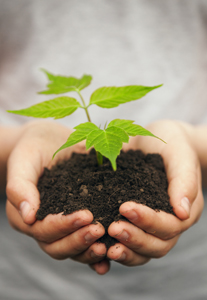
The idea for Earth Day was the brainchild of Gaylord Nelson, a senator from Wisconsin. He envisioned an Earth Day that would be a kind of environmental teach-in. The first Earth Day celebration took place on April 22, 1970, and a surprising 20 million people participated on that day. Ultimately, it became the largest organized celebration in US history.
Earth Day Over the Years
Over the years, the recognition of the day, and the number of people celebrating it all over the world, turned Earth Day into an international celebration. Because it is celebrated throughout the world, it is not only the largest international environmental observation, but it is also more widely celebrated than any other environmental event in the world. Today, Earth Day is celebrated in 175 countries where over 500 million people participate in celebrations.
The Earth Day Movement
The Earth Day movement is credited with developing the idea that people should “think green”. It encouraged congress to enact laws, including one that resulted in the creation of the Environmental Protection Agency. It also inspired the passage of the Endangered Species Act.
The Five R's and Their Importance
- Reduce – Reduce by avoiding unnecessary purchases. Reduce your use of materials that wind up in landfills. Reduce the use of chemicals around your house. Reduce your use of disposable bags, plates, cups, eating utensils, and batteries.
- Reuse – Instead of using plastic bags for your groceries or purchases, bring your own reusable bags. When you go to buy coffee at Starbucks, take a travel mug so you don't have to get your coffee in a disposable paper cup. Instead of storing food in disposable refrigerator containers, buy containers that can be washed and reused. Don't use regular batteries. Whenever possible, opt for rechargeable batteries that you can reuse.
- Recycle – Most cities offer a recycling program to collect used bottles, cans, and newspapers. Recycling includes collecting recyclable materials that would otherwise be considered waste, sorting and processing recyclables into raw materials such as fibers and manufacturing raw materials into new products.
- Re-buy – Make an effort to purchase things that are made through recycling. When purchasing furniture, look for items that are made from reclaimed wood. When buying paper for kids school work, computer printer paper, holiday cards, or anything else, make a point of purchasing recycled paper products. Instead of buying clothing at full retail price, shop for second hand clothing. You will save a lot of money by doing so!
- Rethink – Rethink the way you do things so that you do them in an eco-conscious way at all times. Instead of driving to work alone, consider taking the bus or going in a carpool. Walk or ride your bike when you're only going a short distance. Plan your shopping trips and errand runs so that you can do everything on one day, and do it in a way where you can save time and gas.
Other ways to "think green" include growing your own food, composting yard waste and food scraps, or by participating in local recycling programs. Join a group like Freecycle so you can share your unneeded and unwanted possessions with people who can use them. Likewise, you'll be able to get things you need or want for free.
Earth Day teaches people that the planet belongs to everyone, so everyone is equally responsible for protecting it. Although Earth Day is an environmental celebration, our team at our office wants to remind you that you don't have to wait until then to make changes that will allow you and your family to live a greener life.
Happy Earth Day from the team at our office.
April 17th, 2024
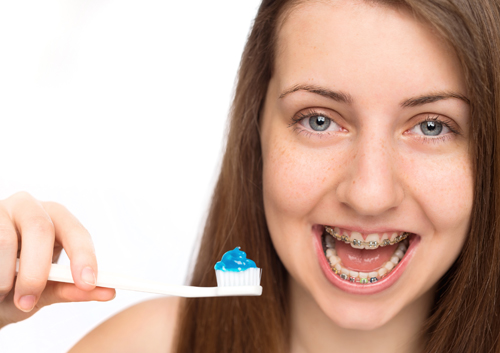
A clean mouth is a happy mouth. And when Dr. Mark L. M. Powell and our staff see you have a clean mouth, we are happy too. Of course, all of this should make you happy because you’re the one preventing sneaky little food bits from getting trapped under the wires of your braces.
Still, you need to be thorough with your brushing. When you have braces, you’re playing a game of hide-and-go-seek with everything you eat. Here are five tips to keep your mouth (and us) happy.
- How is brushing with braces like geometry? It’s all about the angles. Brush the tops of your teeth and braces with your brush angled down. Brush the bottom of your teeth with the brush angled up. Pointy brushes, aka interproximal brushes, are good for reaching the tiny spots around braces.
- Brush after every meal. If those sneaky little food bits hide in your mouth for very long, they’ll turn into plaque. And plaque is a sign of a very unhappy mouth.
- Brush one tooth at a time for at least ten seconds, and pay close attention to the spots where your braces touch your teeth.
- Fluoride is your new BFF. Make sure your toothpaste and mouthwash contain this cavity-fighting ingredient.
- Braces are no excuse not to floss. In fact, saying you can’t floss because you have braces is like saying the dog ate your homework. Dr. Mark L. M. Powell and our staff, like your geometry teacher, aren’t going to buy it. Be sure to floss after every meal.


 Website Powered by Sesame 24-7™