Our Blog

How can I protect my child's teeth during sports?

January 21st, 2016

Sports are great for children for a variety of reasons. Children can develop their motor skills, learn how to solve conflicts and work together, and develop their work ethics. As a parent, you may recognize the benefits of sports, but also naturally worry about your child’s health and safety. Your job goes beyond providing a water bottle and making sure your child follows the rules of the game.

Although you may not think of your child’s teeth first when you think about sports, accidents can happen that affect your children’s teeth. A stray hockey stick, an errant basketball, or a misguided dive after a volleyball are examples of ways a child could lose a tooth. In fact, studies show that young athletes lose more than three million teeth each year.

Becoming a Better Athlete to Protect Teeth

Becoming a better athlete involves refining skills, learning the rules of the game, and being a good sport. These components are not just about winning. They are also about safety. Young athletes who are better ball-handlers and who are careful to avoid fouls and penalties are less likely to have harmful contact with the ball, teammates, or opponents. Children who are better roller-bladers are less likely to take a face plant into the blacktop, and more likely to save their teeth. Being a good sport and avoiding unnecessary contact is one way to protect teeth.

Proper Protective Equipment for Teeth

If your child is in a sport that poses a high threat to teeth, it is essential for your child to wear a mouthguard. Mouthguards fit your child’s mouth and consist of soft plastic. Dr. Mark L. M. Powell can custom fit a mouthguard if generic ones are uncomfortable. While children may resist wearing a mouthguard initially, your persistence in insisting that they wear it should be enough to convince them. A helmet or face mask provides additional protection.

While prevention is best, rapid treatment can improve the situation if your child does happen to lose a tooth during sports. Rapid implantation can work in about ten percent of cases. To learn about ways to save a lost tooth, contact our Jenison, MI office.

TMD Problems and How You Can Prevent Them

January 14th, 2016

Temporomandibular joint disorders (TMD) describe a set of conditions that involve trouble with your jaw and face muscles. They result from a problem in the temporomandibular joint (TMJ), which is a hinge that connects the temporal bones, in your skull in front of each ear, to your jaw. The joint enables you to talk, yawn, and chew by letting your mouth move.

TMD can be very painful and interfere with functions such as eating and speaking. This what to watch for and how to try to prevent TMD.

Risk Factors for TMD

You are at higher risk for TMD if you are a women than if you are male. The disorder is most common among adults between the ages of 20 and 40 years. Other risk factors for TMJ disorders include the following.

  • Arthritis in the area, making movement more difficult
  • Excessive tooth grinding, because it increases stress on the joint
  • General stress, which can lead you to clench your teeth and strain facial muscles

Symptoms of TMD

Symptoms of TMD can last for just a short while, or for several years. Seeing Dr. Mark L. M. Powell is important if your symptoms make it impossible for you to eat regularly or if you have unbearable pain or discomfort. The following symptoms can occur on both or one side of your face.

  • Aching or very tired facial muscles
  • Jaws that are fixed open or shut without you being able to unlock them
  • Grating or popping sounds when you chew or close or open your mouth
  • Pain in the entire area, including the mouth, jaw, neck, or shoulders, that comes on when you chew or yawn

Preventing TMD

You can try to prevent TMD by focusing on reducing risk factors. If you grind your teeth at night, ask Dr. Mark L. M. Powell about wearing a mouthguard. If you are overly stressed, look into ways to better manage your stress and relax your muscles. Another strategy for trying to prevent the development of TMD is to avoid chewing gum, since that puts stress on your jaw.

If you have questions about TMD, don’t hesitate to contact our Jenison, MI office.

My Mummy had Braces! Weird Facts about the History of Braces

January 7th, 2016

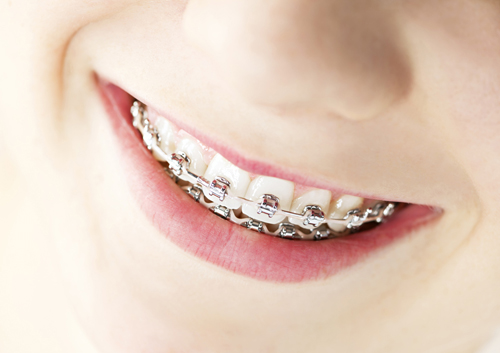
Sometimes real life is stranger and more interesting that any made-up story. These weird and interesting facts about braces will amuse you … and make you glad you didn’t have to get braces “way back when.”

Mummies with braces: Archaeologists have discovered mummies with crude bands of metal wrapped around their teeth. The metal was wrapped around each individual tooth, and it is believed that ancient dentists used catgut to guide the teeth and close the gaps.

First “official” braces: The first official braces were constructed in 1728 by Pierre Fauchard. They consisted of flat strips of metal. String was used to connect the metal to the teeth.

Early rubber bands: In 1850, Tucker began making rubber bands out of rubber tubing.

Brackets are better: Brackets were invented by Edward Angle in 1915. They were not bonded to the teeth directly, but instead were attached to bands that went around the teeth.

Wiring by NASA: As braces have become more modern, the technology has improved by leaps and bounds. You may know that some braces wire contains nickel titanium. What you may not know is that this metal was developed by NASA and has special shape memory that is activated by pressure or body heat.

Over 60 with braces: Actress Faye Dunaway got braces at the age of 61, which shows you are never too old to look more fabulous!

Oh, and one more thing that didn’t quite make our list, but is interesting all the same. Did you know that almost 25 percent of patients who get braces have to get them again because they wouldn’t wear their retainers? So suck it up, buttercup, and use that retainer!

Five Reasons for Your Bad Breath

December 31st, 2015

Bad breath, or halitosis, is probably not a matter of life or death. But it can make you feel self-conscious and have a negative impact on your life. The majority of people suffering from bad breath are dealing with oral bacterial. However, there are other causes of this embarrassing problem. Learning more can help you fight this solvable problem.

Five Causes of Embarrassingly Bad Breath

  1. Dry Mouth. A decrease in saliva flow can be caused by several things. Most often, medication or mouth breathing are the culprits. As saliva helps wash away food particles from your mouth, it prevents bad breath. Dry mouth can be dealt with by stimulating salivation.
  2. Gum Disease and Poor Oral Hygiene. Not brushing and flossing well enough or with enough frequency can lead to gum disease, which leads to bad breath. Halitosis can be a sign that plaque is present on your teeth.
  3. Food-Related Bad Breath. Food particles that aren't brushed or flossed away attract bacteria that leads to bad breath. It's especially important to brush after eating strong-smelling foods, such as garlic or onions.
  4. Smoking and Tobacco. Tobacco is bad for your health, and that includes your oral health. Smoking or chewing tobacco can contribute toward the development of gum disease, as well as oral cancer.
  5. Mouth Infections and Other Medical Problems. A mouth infection, sinus infection or even the common cold can cause you to temporarily have bad breath. Even conditions such as diabetes and reflux can cause halitosis. It's always wise to see Dr. Mark L. M. Powell to help determine the cause.

We are Your Ally

Even if you maintain good oral hygiene, it's important to see Dr. Mark L. M. Powell at our Jenison, MI office to deal with or avoid problems with bad breath. We can help you uncover the cause of halitosis, while also providing solutions that allow you to enjoy fresh breath without relying on mints and breath fresheners. As is the case with all things related to oral health, we are your number-one ally when it comes to eliminating the problem of bad breath.