
Our Blog

At what age should my child have an orthodontic evaluation?

April 22nd, 2026

You may have noticed that kids seem to be getting braces and other orthodontic care a lot earlier these days. There was a time, only a decade or two ago, when braces were mainly seen on teenagers, but that is beginning to change. If you’re wondering when to bring your child to our Jenison, MI office for an orthodontic evaluation, the answer actually has several parts.

The Telltale Signs

If your child has a very crowded set of adult teeth coming in, or if the permanent front teeth came in very early, these are signs that your child should see Dr. Mark L. M. Powell, regardless of age.

The Dental Age

Barring signs of trouble or early adult teeth as mentioned above, the time that your child needs to be seen for initial orthodontic evaluation depends not so much upon your child’s actual age, but on what is known as a “dental age.”

The dental age of the patient might be entirely different from his or her actual chronological age; for example, an eight-year-old could have a dental age of 13. It is part of Dr. Mark L. M. Powell and our staff’s job to determine the dental age and then make appropriate recommendations for the resolution of orthodontic issues if they are emerging.

The Official Recommended Age

The American Association of Orthodontists officially recommends that kids should see an orthodontist for the first time between the ages of seven and nine. Even if the child does not have all his or her permanent teeth, the teeth growth pattern can usually be predicted quite effectively by an orthodontist.

This allows for a proactive response to emerging problems, and this is the reason that some younger children are now getting orthodontic devices earlier in life. If a young child has serious orthodontic issues emerging, Dr. Mark L. M. Powell can usually address the problems immediately and then follow up with another round of treatment when the child has all the adult teeth.
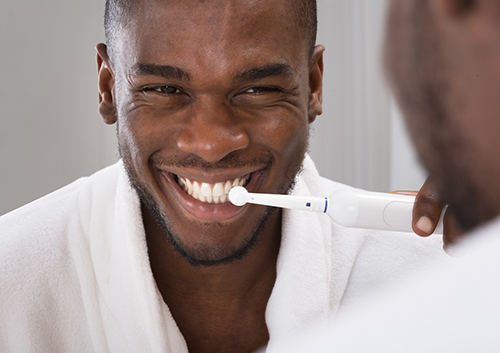

Electric Toothbrushes vs. Regular Toothbrushes

April 15th, 2026

Convertible or sedan? Downtown or suburbs? Electric or manual toothbrush? As life decisions go, it’s certainly not choosing your next car, or deciding where you want to live. But, even when you are selecting a toothbrush, it helps to make a list of the pros and cons of the contenders before you make that final selection.

  • Efficiency

The most important factor in choosing a toothbrush is finding out which model works best to eliminate bacteria and plaque. And studies have shown that, used properly, both electric and manual toothbrushes do a great job of removing plaque. Some electric models can reach the backs of teeth and the gumline more easily, some manual head designs work better for your individual mouth and teeth, so your particular needs should dictate which style of toothbrush you use. Talk to us about the best methods to brush with your preferred toothbrush, and we’ll let you know if one type of toothbrush or the other might work better for you.

  • Health Considerations

Brushing too energetically can actually harm teeth and gums, causing sensitivity and damage to the enamel and gum tissue. An electric toothbrush should provide a continuous brushing motion without needing any pressure from the brusher. This might be the model for you if you have a too-vigorous approach to brushing, or sensitive teeth and gums.

An electric toothbrush can also be more efficient for older and younger brushers, those with limited mobility, and those with health conditions or injuries that make brushing with a regular toothbrush more difficult.

  • Cost

An electric toothbrush is not a one-time investment. You should change the removable head as often as you change your manual toothbrush (every three to four months, please). But this cost is offset if an electric toothbrush is more efficient in removing your plaque, easier to use, or even if you just prefer it to manual brushing. If you find that you brush better and more often with an electric toothbrush, the added expense is well worth it.

Whichever brush you decide on, the most important part of the brush is the person holding it! A regular appointment with your toothbrush for two minutes of thorough brushing in the morning and two in the evening, daily flossing, and regular visits to our office for checkups and cleanings will keep your teeth healthy and strong no matter which toothbrush you choose.

Questions about your toothbrush choices? Don’t hesitate to ask Dr. Mark L. M. Powell at our Jenison, MI office.

Sugar and Your Orthodontic Treatment

April 8th, 2026

One word no one likes to hear is “cavity!”

For those patients of ours wearing braces, hearing that word is especially problematic, considering that delaying any dental work may result in delaying treatment time.

We often blame candy as the culprit behind tooth decay, but other foods and drinks that kids consume can be just as harmful to their teeth, and can lead to cavities and tooth decay. Keeping your teeth or your child’s teeth from decay during treatment starts with a proper diet, and today, our team at our office will explain the negative effects that candy and other treats, including peanut butter, raisins, fruit juice, and chewy fruit snacks, have on your child’s teeth as he or she undergoes orthodontic treatment. Keep in mind that half of your child’s sugar intake may be coming from beverages that he or she drinks. A major offender is soda, but be mindful of fruit juices as well.

While sugar is known to sit in your child’s teeth and in between and under brackets and wires after consumption, it is important to know sugar is not the only cavity-causing culprit. Carbohydrates, starches, acids, and any food that is chewy or sticks break down into sugars, and can promote tooth decay.

So, what are the alternatives?

Candy such as dark chocolate, sugar-free gum, or anything that contains xylitol, a sugar substitute, is not as harmful for your teeth as hard, chewy, or sticky sweets. Sugar-free gum or gum that contains xylitol are known to reduce levels of bacteria on teeth.

And if you’re still looking for something to snack on, we recommend cutting up easy-to-eat fruits and vegetables. You would also be surprised how much eating a banana or sipping on a glass of water helps you curb snack cravings.

If you’re one of those folks who just can’t stay away from sweets, we encourage you to brush your teeth immediately afterward and swish water in your mouth.

Whatever you eat, Dr. Mark L. M. Powell and our team want you to remember to brush often, floss regularly, and visit your general dentist as your treatment progresses. If you have any questions about sugary foods or drinks, please give us a call or ask us during your next adjustment visit!

Time for Some Spring Cleaning!

April 1st, 2026

Just like that, it’s Spring, and the world looks brighter! The skies are sunnier. Daylight in Jenison, MI lasts longer. And your smile can be brighter, too—with a little bit of spring cleaning.

After all, sometimes dental habits become so automatic that we don’t pay them as much attention as we should. Without careful daily brushing and flossing, you could start to see surface staining on your enamel. Or red and swollen gums. Or plaque buildup around your brackets. Or tartar deposits along your gumline and behind your teeth.

The start of the season is a good time to spring ahead with a plan for better oral health, and we have some simple ideas to help you clean and protect your smile all through the year.

Assemble the right tools.

  • Use a soft-bristled toothbrush, because anything firmer can be hard on your tooth enamel and gums. If you’re having trouble removing food particles and plaque, especially around brackets and wires, an electric toothbrush might be a game changer.
  • Find the right floss. If you’ve been neglecting flossing because it’s difficult, especially with braces, there are lots of options available for better, easier cleaning. Whether it’s floss threaders, floss picks, interproximal brushes, or water flossers, Dr. Mark L. M. Powell can recommend the best products for cleaning around your brackets and wires.
  • Choose fluoride toothpaste. Fluoride not only helps prevent cavities by creating an unfavorable environment for cavity-causing bacteria, it also actually strengthens tooth enamel as well. Win/win!

Use those tools!

  • Brush all the surfaces of your teeth carefully (no need to scrub) and brush along the gumline at a 45˚ angle. This will help prevent plaque from accumulating above and below the gumline, where it can harden into tartar.
  • Brush often enough and long enough. Dentists generally recommend brushing twice a day, for two minutes each time, but you might need to increase your brushing schedule when you wear braces. 
  • Brush before replacing aligners or wearing your retainer. You don’t want to trap food particles or bacteria in your appliance!
  • Floss at least once a day, or more often as recommended. Proper flossing can be tricky sometimes, especially with braces, so ask your orthodontist, dentist, or the care team at our office for the best techniques for your teeth.

Make sure your dental products are in top shape.

  • Replace your toothbrush as often as necessary. After three months or so, bristles start to fray. They don’t clean as effectively, and they could be abrasive to gum tissue. Change out your brush every three to four months, including the head on your electric brush. A good way to remember is to change your brush with the change of seasons. 
  • Check the date(s)! Many toothpastes, mouthwashes, and other oral supplies come with a “best used by” date, ensuring that your products remain safe and effective.
  • Choose the right toothbrush holder. Your brush should air-dry upright, because germs thrive in closed, damp environments. And your holder shouldn’t allow your brush to touch other people’s brushes to avoid transfer of bacteria and viruses. Clean your brush holder regularly to remove toothpaste residue and germs.
  • Clean your aligners, retainer, mouthguard, night guard, and/or cases for your appliances as recommended. Bits of food, bacteria, viruses, and other germs collect there as well.

Work with the experts for your brightest smile.

  • See your dentist regularly. You’ll discover any problems which might be dimming your smile, and you’ll discover them early.
  • Schedule cleanings with your exams. Your hygienist uses tools such as ultrasonic or hand scalers and polishers to remove stubborn plaque, tartar deposits, and surface stains that brushing can’t.
  • If you want brighter teeth, talk to Dr. Mark L. M. Powell or your dentist to discover the best time for whitening treatment. And when the time is right, consider professional whitening. While whitening kits are available in almost any drug store or supermarket, office treatments or kits provided by your dentist use stronger ingredients and are more effective.

Easy steps, yes? Step up your cleaning routine, and you’ll have a springtime filled with not just brighter smiles, but healthier smiles, too!